
Substack Notes Was Always Going to End Up Here.
A Report on the Decline of Moral Profitability and Other Nonsense


The Promised Land
Substack was supposed to be a new beginning—a refuge for writers who believed discourse was a metric that mattered. No ads, no algorithms to track, no endless scroll to trap the mind. It marketed itself as the new home for old souls.
The pitch was simple: “Escape the algorithm.” “A better internet for writers.” “An economic engine for culture.” Slogans sounding like a sales brochure for a gated community of ideas that flattered your higher self while taking a cut from the property value. Time shares for your attention.
It knew what we knew. We were exhausted. Exhausted by feeds built on outrage. Watching the worst voices carry furthest. Jaded by clickbait con artists stealing our attention. Substack was the antidote. It zigged where others zagged, with longform content, direct relationships, and soft launches of crypto bros selling masculinity as an asset class.
The pitch landed. It was a relief to many. Declaring their independence, writers fled Twitter like Bolsheviks with ring lights. They wrote about the dignity of contemplation. Of paragraphs that could sing. Discourse that educated. It worked. It was also, inevitably, compelled by the same market forces that every for-profit company must adhere to.
And then, to nobody’s surprise, came the Notes feed.
A page we can’t escape. Hearts. Restacks. Followers. Feedback loops that reward mimicry. Dashboards that treat users like metrics. Just like that, Substack became the platform it meant to disrupt. People began checking their engagement stats before Krav Maga. Posted clickbait only after they checked their meme stocks.
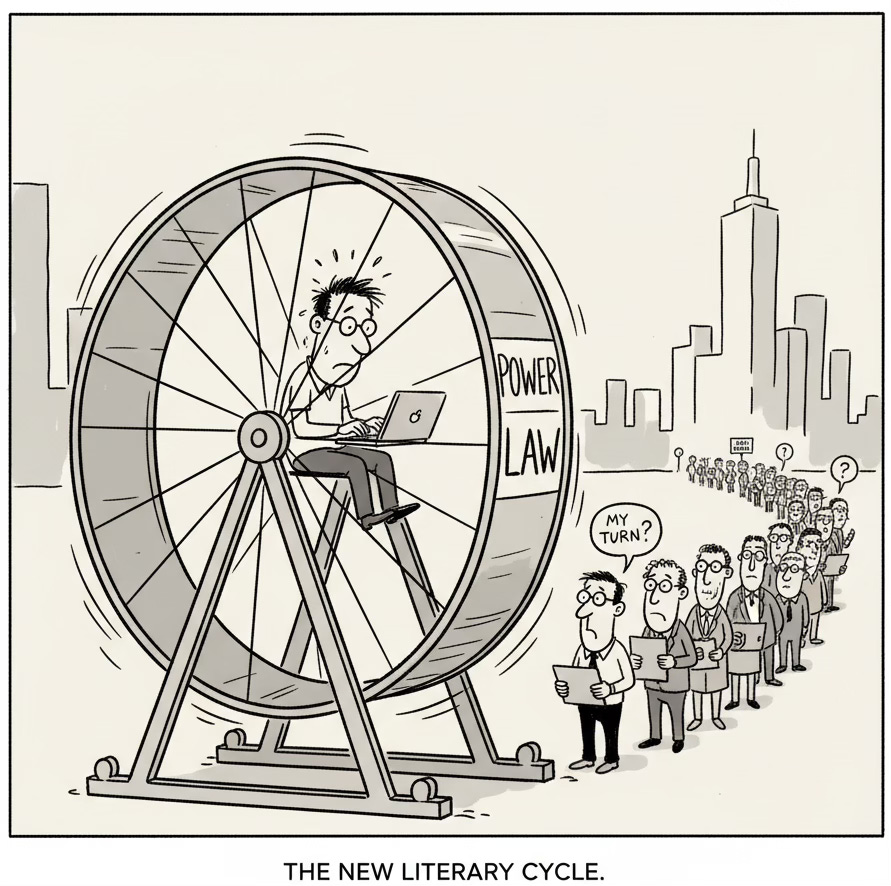
But what changed? Not human nature. Investors. When Substack raised venture funding, it accepted a constraint more powerful than any belief: the power law.
Substack became what its investors needed it to become.
The Mathematics of Squalor
Every venture-backed company is a prisoner to the power law.
In venture capital, the power law means a few bets make all the money. Home runs not singles. Big swings need speed and scale. Power law doesn’t care how you do it. Just that it’s done. And on time.
As of the time of this writing, Substack is worth $1.1B. It generates only ~$45M in revenue. That’s a Price/Sales ratio of 24.4x. For comparison, that’s roughly 300% higher than publicly traded SaaS (Software-as-a-Service) companies. Investors’ fortunes are tied entirely to the future profitability of Substack.
The arithmetic: simple. For investors to see returns, Substack has to be worth billions. A lotta billions. But you don’t get to a lotta billions with a thousand writers making comfortable livings posting short stories about the daily trauma of doing laundry.
The playbook: Explosive user growth. Network effects. Engagement metrics that make advertisers salivate. Let’s not kid ourselves. There will be ads. Just as sure as I am that you should drink AG1. I get all my nutrients in a convenient green powder that vaguely resembles Kermit the Frog if he were cremated. AG1.

To placate investors, a startup has to scale at rates that preclude curation. Deliberation is aerodynamic drag. In media, that means hijacking our nervous system. Killer hooks. Quick reads. Dopamine hits. The result is predictable. Every feed becomes every other feed.
Slow writing clashes with exponential growth. A seven-day essay can’t compete with a thirty-minute jot that elicits instant reactions. My essay on market psychology—researched, revised, and restrained—got 16 views. One. Six. The listicle promising “10 things successful people never do”? 1,500 likes and 200 restacks. The algorithm chose this outcome. Power law required it.
Reflection and depth aren’t scalable metrics. It’s haute couture for the refined reader. Scale favors fast fashion content: easily produced throwaway thoughts for the masses.
The system is ruthlessly efficient at recognizing our wants. And it provides, predictably, in abundance.
Venture math buried virtue behind the barn and told us it ran away. Once a company accepts the arithmetic, it’s bound to the playbook. “Conversation” becomes “Engagement.” “Trust” becomes “Growth.” “Community” becomes a screaming contest.
The algorithm can read, but it’s made to measure reactions. Assessing quality writing—substance, intellectual precision, or poetic prose—amplifies compute cost. It’s hard to rationalize increased overhead for a smaller, less profitable audience.
Clicks, likes, and dwell time are cheap and fast to measure. Power law is the path of least resistance to billions. The system predictably promotes what people pretend to hate but actually want: clickbait.
The Playhouse of Sincerity
Virtue didn’t die on Substack. It’s in the marketing strategy. Writers once scorned statistics; now they show screenshots,seeking the soft sign of a subscriber count. Readers play the pseudo-intellectual, sharing what sounds smart. Virtue became digital bling.
It’s easy to scapegoat the algorithm. In truth, it’s a reflection of us. It shows us what we want: ourselves.
We say we want depth. Nuance. Complexity. We say we’re tired of algorithmic manipulation. Then we click on soft porn productivity hacks and refresh our follower counts.
But money talks.
The chasm between stated values and actual behavior isn’t hypocrisy, it’s revealed preference, power law betting on our actions, giving our empty thoughts the silent treatment.
So we’re the star in our own show. Playing dress up. The thinker. Or the moralist. Convinced we’re delighting others. Not knowing they’re too busy playing their part.
Notes is where clickbait puts on glasses and quotes Baldwin.
The Law of Diminishing Virtue
A better world could exist. One where writing meditates and paragraphs exhale. Where readers deliberate, challenge, grow. It could work. It just wouldn’t scale. The audience for meaning is embarrassingly small. The rest write dinosaur erotica, proving love finds a way.
Quality has an audience, but not a growth curve. A venture-backed platform requires scale. Scale demands speed. Speed feeds emotion. Emotion feeds scale.
Depth requires silence. Reflection demands time. And venture capital, deaf to both, cannot fund restraint.
That’s the paradox. The audience for truth exists, but the power law turns its back. It could work as a business, but only if ownership valued ideals over profits. Maybe it survives better as a non-profit, where the goal is understanding, not valuation. Once you’ve taken venture money, there’s only one path left: Pander. Provoke. Grow.
So the cycle resets. A new platform emerges, promising depth, community, quality writing. The idealists migrate again, convinced this time will be different. They breathe in hope like it’s oxygen. They’ve found a home. They’ve been heard.
Then the funding. Then the feed. This isn’t like all the other feeds, they say; “Escape the algorithm.” “A better internet for writers.” “An economic engine for culture.”
Then the slop comes.
The tragedy isn’t that Substack became what it replaced. It’s that it had to. Any company beholden to the power law ends up feeding the lizard brain. That’s where billions are made.
Virtue can’t be scaled. You can’t IPO thoughtfulness.
And the only people still reading this far are the ones no platform can afford.
Write something below so I can pretend this is a conversation.
Love this, Ryan! Part financial analysis - part poetry - part existential philosophy. Super insightful and pure literary pleasure to read.